
Write Around the Corner
Write Around the Corner: Donna Andrews
Season 8 Episode 10 | 27m 43sVideo has Closed Captions
Donna Andrews talks about her books that are chocked full of humor and homicide.
Donna Andrews, the New York Times bestselling author of the Meg Langslow mystery series, talks about her books that are chocked full of humor and homicide.
Problems playing video? | Closed Captioning Feedback
Problems playing video? | Closed Captioning Feedback
Write Around the Corner is a local public television program presented by Blue Ridge/Appalachia VA
Write Around the Corner
Write Around the Corner: Donna Andrews
Season 8 Episode 10 | 27m 43sVideo has Closed Captions
Donna Andrews, the New York Times bestselling author of the Meg Langslow mystery series, talks about her books that are chocked full of humor and homicide.
Problems playing video? | Closed Captioning Feedback
Where to Watch Write Around the Corner
Write Around the Corner is available to stream on pbs.org and the PBS app.
Providing Support for PBS.org
Learn Moreabout PBS online sponsorship-[Female VO] This program is brought to you by the generous support of The Secular Society, advancing the interests of women in the arts in Virginia and beyond.
♪ ♪ ♪ ♪ [male singer] Every day, every day, every day ♪ ♪ Every day I write the book ♪ -Welcome.
I'm Rose Martin.
And we are Write Around the Corner in Reston, Virginia, with New York Times and multiple award-winning author, Donna Andrews.
She's a master of humorous traditional mysteries.
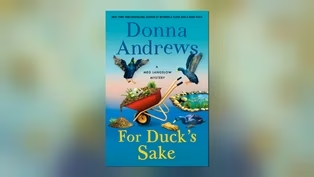
And today, we are waiting or waddling into For Duck's Sake .
You know, it's more than a Mutt March when a skeleton is found, as in all of Donna's books, it's humor and homicide.
Welcome to Write Around the Corner, Donna.
-Thank you for having me.
-And thank you for inviting us here.
And I love this big tapestry on the wall because your books are known for birds.
-Yes.
And also, Meg is a craft person too.
And this is a-- I used to be a-- I'm a craft fair junkie.
I go to craft fairs a lot.
And it used to be, "Oh, there's Donna going and spending money at a craft fair again."
But once I started writing about a blacksmith, it became research.
-And how did you decide Meg was going to be a blacksmith?
-Well, at the time I started writing her, I was--I still had a day job, and I didn't think it would be very interesting for the reader if you're a detective was sitting at a computer in an office 9 to 5, I mean, when do you sleuth if you're sitting at a computer in an office all day?
And since I loved going to craft fairs, and one of my favorite things to watch at the craft fairs was to watch the blacksmith.
And I thought, "Oh, if she's a blacksmith, then nobody's going to give me a hard time."
I don't like to have her rescued.
I like her to rescue herself or rescue other people.
She can be rescued sometimes, she can get help, but I don't want her to be one of those helpless female protagonists.
So I figured if she's a blacksmith, no one is going to argue.
And there's even one book, we will not give away the spoiler, there's even one book where she has a sword fight with the bad guy at the grand finale of the book.
And she's a blacksmith and she makes swords.
She can do that.
So, yeah.
-Oh, wonderful.
-Little teaser for everybody.
-Oh, yeah.
-And you talked about sleuthing.
So I understand you went to a P.I.
class.
-Yeah.
At one point, I had another series that only went for four books with an artificial intelligence named Turing Hopper, who began sleuthing when the programmer who created her disappears.
And one of--and since Turing couldn't leave the computer, I need-- she needed human sidekicks.
One of her sidekicks was the guy who works as the Xeroxist, the copy operator in the big company, and he always wanted to-- he loved noir detective stories.
He always wanted to be a detective.
So at the end of that book, I had him sitting in his detective office with putting his feet up and welcoming his first client.
And then I realized, I had to write the sequel, and he was going to be a P.I.
in the sequel, and I had no idea what a P.I.
really did.
So I took the class in order to find out what a P.I.
did.
It was great because every time the instructor, Martha Clancy, said, "When you get out of here and are on the streets working, I don't ever want to hear that you did."
I know--that's something my bumbling P.I.
could do.
-Um-hmm.
-So I learned a lot.
And I also got a lot of plot material from that.
-That's fun.
-But it was fun.
-I've never worked as a P.I.
-Yeah.
But I got to hang out with P.Is which was cool.
-And you get to write it all into your books, which is really fun.
So the earliest story, I read that your earliest story may have been second or third grade.
Your father being a marine biologist.
-Yes.
-Tell me the story of the clam and the saltwater tank.
-Yeah, I had-- my dad was a marine biologist specializing in oysters, but he had friends who did clams and crabs and everything.
And my teacher, Miss Gregory, who was-- she was an actress who also taught-- she worked in local theater.
Actors and musicians make great teachers.
And she talked to dad and he agreed to bring a saltwater aquarium in.
One day, she noticed that the clam had died.
So she took the shell, cleaned it out, and gave it to me to take home as a subtle hint to my father that we needed a new clam for the aquarium.
Instead of doing this subtle hint, I taped it together with that white medical tape, pointed eyes on the outside of it, named it Winifred H. Clam, and began writing about Winnifred H. Clams Adventures, walking around the earth under sea.
And my teacher loved these stories so much.
She took them to one of her friends at the theater, and the friend was charmed.
I think--I could have been at most a third grader at that point, and the friend sent back a little gold colored, clam shaped charm as to-- and thereby instilling in me at an early age, the very false idea that if I write something, it'll be rewarded with, you know, gold.
-Oh, yeah.
-Yeah.
-So then how much time went between that first book and then when you-- were you always writing stories or then you just-- -Always writing.
Well, I mean, I started writing about Winifred H. Clam, you know, they give you these line tablets, you're supposed to practice your handwriting?
-Yeah.
-And everybody else is practicing their handwriting and I'm writing stories.
But I continue to write through grade school and high school.
And when I went to college, I did a double major in English and Drama, playwriting in the drama department, playwriting and costuming at UVA, and writing short stories, and eventually a novel in the English department.
So I never stopped.
It just took me a while to get published.
-Yeah.
-[chuckles] -And that story is so familiar.
So your time growing up in Yorktown, and we have a similar history, not as a writer for me, but being in Yorktown.
So you finally thought, "Well, I can't really keep this settled in Yorktown," so you created a cool name for the city.
-Yeah.
-What is it?
-It's actually Virginia mugs, the British Isles for all the place names.
So I chose a Welsh name, Caerphilly.
And it was-- it wasn't so much that I didn't like putting it in Yorktown, but with my-- my first book was in Yorktown, the second was on Monhegan Island of the coast of Maine, then I took it back to Yorktown for the Yorktown Day ceremonies, which is a big-- it's a big annual celebration of the end of the Revolutionary War.
But I had a deputy there, Deputy Montgomery.
It's a name out of my own family tree.
But every--I got a dozen inquiries about, "So which Deputy Montgomery in the York County Sheriff's Department is?"
And he wasn't exactly a nice guy.
So I decided it was safer to take it to a fictitious town.
-Sure.
-Because, I mean, Yorktown does not have a small private zoo owned by my heroine's grandfather.
There isn't actually a college located in Yorktown, but it--but Caerphilly is very much modeled on Yorktown when I grew up there and Charlottesville when I was going to school there.
You know, small town with a lot of history dominated by a large college.
So it--but I didn't have to worry about people thinking, "That's based on me."
-Um-hmm.
-Yeah.
I actually at one point, my mother kept saying about Meg's mother, "Is that how you see me?"
-Oh.
-"Is that--?"
And I finally said, "No, Mom, it's so and so's mom."
And she thought-- and she'd never met this woman, but she'd heard the stories.
And she said, "Oh, I can see that."
And she never worried about it again.
I was about to give her an affidavit that I hadn't based.
The only thing that space there are two things that I stole from my mother.
One is having a very large family.
Mother was an only child, but both of her parents had large families.
And the idea that-- I mean, there are so many relatives in the area.
My mother and her best friend, after 25 years of trying, finally figured out how they were related.
They were distantly related by marriage.
And the other thing is her dislike for coconut, that she opens up the candy and if it's coconut, she puts it back together again.
-Oh, so you're not a coconut either?
-I'm not.
My mom wasn't.
I take after her in that way.
But Meg's dad is definitely inspired by my dad.
-Okay.
-I changed all the particulars.
My dad is tall.
Meg's dad is short and plump.
Dad--Mom's cooking got to him eventually, but not for a long time.
Dad was a marine biologist, not a doctor.
His hobby was opera and French culture, not mysteries.
He was a gardener, but not a poisonous plant.
But the character being so passionately involved in whatever he was interested in, the classic story that I always tell as an example of how obsessed dad was, he was reading-- he read a book about the French writer, Georges Sand, and he would read passages from this book to us.
He would, you know, everything was related to Georges Sand that year.
And at one point, he was-- we were having a conversation, it was about school or something that was going on in the neighborhood, and in microseconds pause in the conversation, Dad said, "So speaking of Georges Sand..." -Like that's what you're talking about.
You're like, what?
Where did that come from?
-But something we had said reminded him of something from her biography.
So yeah, that you know, absent tunnel vision when you're focused on something and he recognized himself.
Everyone who read the book said, "You based him on your Dad, didn't you?"
And at first, he was kind of embarrassed, and then he kind of got into it.
And I remember, you know, you did the Sunday call and he was like, "Well, I did something this week "that you're probably going to want to use when I tell you about it."
He was auditioning.
[chuckles] -Oh.
-So he wanted to give you additional material because then he kind of liked being in the book.
Yeah.
-He got fond of it, I think.
-Oh, that's fun.
-And his family loved, you know, knowing that it was inspired by him.
-And I understand Spike is also?
-Spike was a real dog.
-Okay.
-Spike--my friends, Tracy and Bill adopted-- they thought it would be really cute to get a tiny little dog and name him Spike and have one of those spiked collars.
-Um-hmm.
-They got a Misty Chihuahua, pound puppy.
He'd been on the streets for a while.
Spike, Spike was a spike.
He was fierce.
He would literally bite the hand that would feed him while it was feeding him.
I was one of the few pe-- I mean, when the first book came out, he died shortly before I turned the book into my editor because he was not a spring chicken by that time.
And at one point I-- you know, Tracy was saying, "It's so nice.
He'll live on in your book."
And I said, "I could change-- I changed the name."
-And they recognized him anyway.
-Oh.
-And so, "I could change the name back to Spike."
"Oh, would you?"
They gave a copy of that book in hardcover to everyone he'd ever bitten.
-Oh, really?
-Several dozen copies that I had to sign, "In memory of Spike."
-Oh, I love that story.
-Actually, we signed-- I signed them Cubby Spikum .
You know, Cubby Canum, Cubby Spikum.
-Yeah.
-You know, that dog had lived another few years.
-[chuckles] -Oh, I love that.
So the whole idea of the birds, I understand a friend of yours kind of helped that initiation of the of things happening around birds and titles.
-Quite accidentally, I was entering a contest, my publisher runs Macmillan, I'm with Minotaur, which is an imprint of Macmillan, and they have a contest every year, several contests for unpublished manuscripts, it's a very legitimate contest.
One of the ways you can tell it's legitimate, it doesn't cost money to enter it.
-Oh, that's a good tip.
-Yeah, yeah.
If a contest costs money, it may or may not be legit.
-Um-hmm.
-But I entered the contest, I hadn't titled the book.
At one point, it was going under the three weddings in an undisclosed number of homicides.
It was the best title I'd come up with.
That was too long.
And I called up my friend and said, "What should I call this book?
I need a title?"
And she said-- because she knew, I had discussed several writing projects with her and she said, "Oh, is this the murder mystery with the peacocks?"
Bingo.
But publishers like themes.
And so the second one, for the second one, my friends and I, we came up with all these wonderful puffin titles because it was going to have puffins in it.
And one of my librarian friends, she had like the 100 books, every well-educated person should read, and she puffinized all hundred titles of it.
-Oh, wow.
- War and Puffins .
Crime and Puffins .
The Puffin Who Knew Too Much .
Look Homeward, Puffin .
And I sent the best to my publisher and they said, "Which one are you going to use?"
"For series continuity, we're going to use Murder with Puffins ."
And my--Dan Stashower, another wonderful local writer, was--he was doing a panel that I was on.
He said, "So what large, ungainly bird are you killing off this year?"
And I realized I had to figure out a way to get out of the murder with.
-Yeah.
So I named the third one was the Revenge of the Wrought-Iron Flamingos .
-No actual flamingos.
-Uh-huh.
-And then once, I got to Crouching Buzzard Leaping Loon , because it was a martial arts subplot, we kind of--they like the fact that it's got a bad pun or a silly saying with birds, and they get the cover that has the cute cover with a bird.
-And it's something so recognizable that people almost now probably anticipate like, "What's she going to pick next?
Or what's it going to be?"
-Yeah.
Yeah.
So, and sometimes it's-- I mean, my editor is a stickler for having the bird of the book, not just be a title, but the bird, it's got to be involved, you know.
So, I have to come up with a title that has a bad pun or at least a funny saying with a bird and figure out a way to get that bird involved.
Fortunately, now that my heroine's grandfather, the eminent biologist and environmentalist, has a small private research zoo in the town, I can always have his zoo have some of those birds.
-So which comes first?
The birds are going to pick, and then the pun comes after that, and then you weave it into the story?
-Usually.
If I can come up with a punny title, if I can come up with a punny title, I can then figure out a way to work it into the book.
So once we've got a working title, there have been times when I've started writing the book and had to change the title.
For example, I was-- there was a book, I was going to have a book called Either Eagle Rights or Eagle Opportunity .
They didn't think that sounded mystery enough.
We ended up calling it Die Like an Eagle , but I was already there-- -There, there.
That fits.
-And I was already-- this was-- and there weren't real eagles in that.
It was based around my heroine's twin sons were playing-- not Little League because I didn't want to get all the little, you know, the--I created a fictitious equivalent Little League Summer Ball, and she was helping, and her husband is coaching the summer ball team, and her son's team is the Eagles.
So if I can get-- but there was a real eagle there, kind of like as a mascot.
With Crouching Buzzard Leaping Loon , there was a buzzard that was the company mascot with Gone Gull .
My heroine's grandfather was trying to find a bird that-- a gull that had perhaps gone extinct and maybe been sighted in this one area.
If I can find a title that we're happy with, I can figure out a way to involve.
For example, with For Ducks Sake .
That's one of the few titles I didn't think of.
There was an editor, Madeline Haupt at Minotaur.
My editor, Pete said, "Madeline has a title for you.
See if you like it."
" For Ducks Sake ," I have to say that carefully.
-Yes you do.
-Yeah.
And I said, "If you're going to-- if you all are going to let me use it, I can come up with a duck plot."
-Uh-huh.
-And in the previous book, my heroine's brother and sister-in-law, my--the sister-in-law was pregnant and was giving birth at the-- after the book ended, and I happened to know because I like collecting bird trivia because you never know when it'll spawn a plot.
I happen to know that there are-- some people think there are nutritional advantages to ducks eggs.
There are certain minerals and nutrients that they have more of.
-Better than chicken eggs.
-Yeah.
I'm sure that chicken eggs excel in other areas, but Delaney, Meg's sister-in-law, has gotten gung-ho that she wants to have a duck flock so she can get a good supply of duck eggs by the time her baby is old enough to eat eggs.
So they're digging a duck pond in the backyard, and while they're bulldozing the hole for the duck pond, they come up with a skeleton, which meant we have a cold case.
And I really love-- one of the things I did instead of having a social life during the pandemic has become addicted to true crime podcasts.
And I particularly like it when they manage to solve a cold case.
I love seeing, you know, seeing DNA or clever detective solve a dirty little case.
-And I can see that in your books, how the characters tend to go out and find little things to help solve the case.
But I understand through your plotting process, you used to do, like 20, 30 page outlines, but you're very organized with your spreadsheets.
-Yeah.
Well, that's how I write.
I mean, there are sort of three phases to the writing.
The first phase is the thinking up and outlining.
I don't outline as detailed as I used to, but I still do outline.
And I've discovered-- at one point, I was getting a late start on a book for reasons that were partly my fault, and partly that it took me a while to--I--this one was, I was lobbing titles at my editor and they were never thrilled with them, and I kept lobbing more titles.
By the time we finally got a title, I was several weeks behind when I wanted to start it.
And when you write two books a year, which I've been doing lately, you can't afford to get too far behind on your schedule.
-Um-hmm.
-And one of the things I did, and it turned out to be a very smart thing for some reason, instead of starting to write immediately because I had a general idea what I could do with that title when I suggested the title, I sat down and outlined it in much more detail than I had been doing recently, and it worked out great.
So by the time I started writing the draft, I usually know who done it.
I often know-- I usually know how Meg's going to figure it out, and I probably have a good idea about what kind of dramatic scene I'm going to, you know, have her finally, you know, how the bad guy is going to get the drop on her, how she's suddenly going to realize, you know, I have a really good idea how it's going to work.
-And, you know, what I love is the fact that some of the gory stuff or the oversexualized stuff, that stuff is off stage for you.
That means your books are great for anybody and everybody.
And are you still disciplined with the 1,500 words a day?
-Yeah, I wasn't quite as good this time because I started earlier than I-- I got ready to start early and I had-- I was going through a lot of medical appointments.
I'm limping around on a cane eventually going to get a new hip.
And for some reason that was distracting, but I really--if I sit down and I do a spreadsheet, once I've got the plot, I-- I'm putting myself in draft mode.
I love draft mode because Monday through Friday, I write 1,500 words a day.
And as long as I get my 1,500 words a day, I'm fine.
I'm whatever else goes wrong that day, I'm allowed to consider my day a success if I got my 1,500 words.
-That's pretty disciplined.
-They can be 1,500 really crappy words, but that's okay because they're draft.
-Here's the thing, I want to know about the characters.
So we're going to play, not play a little game, but I'm going to say a character's name, and we want our viewers to kind of learn about the characters in the books and who they are, with just like a sentence or two.
-Okay.
-You describe the person.
-You describe the character.
-Okay -Ready?
-Yes.
-Okay.
-I'm gonna start with Meg.
Meg Langslow.
Meg is my heroine.
She is an ornamental blacksmith who started getting involved in sleuthing because her friends and family were in danger, were suspect, might be the end.
And that's always why she sleuths.
-Okay.
Michael Waterson.
-Michael.
In the first book, she meets Michael.
He's a drama professor.
Used to be a soap opera and cult TV show actor.
Now, he's a drama professor in Caerphilly College, and he's running his mother's dress making shop for the summer.
And that's how she meets him.
Because in the first book, she's involved in organizing three family weddings and-- -Okay, let's stop there for people.
-Okay.
-The twins.
As I said, Meg meets Michael in the first book.
A few books later, they get married and they have twins, Josh and Jamie, and I'm kind of slowing them down.
They probably ought to be a little older than they are, but... -But you have to keep everybody alive, just like the grandfather.
-Yeah.
-I mean, we'll talk about him in a second.
All right, how about Rob?
-Rob is Meg's brother.
Rob, in the first book, he's corrupted, he's finished.
He's gone to law school.
He's actually managed to graduate not too badly from the University of Virginia Law School.
Demanding, not cheap.
And he's supposed to be studying for the bar exam, and instead, he corrupts his bar exam review group to help him invent a game called Lawyers from Hell .
-Okay.
-Which is now a computer game.
-Oh, okay.
Rose Noir.
-Rose Noir is-- her name is Rose Marie Keenan.
She is Meg's-- Rose Noir is Wiccan.
She never met a new age concept she didn't like.
And she she's the-- she's moved in with Megan Michael.
They have a big old house, and she does most of the cooking and helping out.
-Doctor Blake.
-Doctor Blake, Meg's grandfather.
Doctor J. Montgomery Blake, Joshua Montgomery Blake.
That's why they're twins.
One of the twins is Josh.
He's a-- he's an eminent biologist, environmentalist talking head.
You know, when you have the nature shows like... "And now, the mother leopard is teaching her."
-That's him.
-Yeah, exactly right.
And curmudgeonly.
-And we talked about Spike already.
So let's get back to For Duck's Sake .
-There's going to be a Mutt's-- -A Mutt's March.
-And it's so fun.
But yet things can go wrong when the duck pond that they're trying to uncover.
And so I love the fact of where you put humor with mystery, with the same characters who know each other.
And I can't imagine how you keep them all straight to know who graduated, who did what, when at every single story.
-I do occasionally make mistakes and I try to fix it.
At one point, I had Meg say that, you know, I had Meg say that a pity that Rob had never bothered to take the bar exam, forgetting that I'd had him take and actually passed the bar exam in a previous book.
-Ooh.
-Yeah.
-Then did you discover that one of your readers?
-A reader--it's two clever readers noticed that and pointed it out to me.
I was, "Oh, what am I--" what I did, I had him say something like, give some actual, like, sound legal advice about getting a lawyer when you're doing something very basic, like, "Well, maybe you weren't wasting your time at law school."
And he says, "Yeah, maybe next time you won't tell people I flunked the bar exam."
And she said, "I never said you flunked it.
"I just said, you probably lied to us "and told us you passed it "because you knew you didn't want to practice law and didn't think it was worth the bother."
-You're clever.
You're so clever.
-And he says, "Well, when you say it like that, it actually sounds like a compliment."
-How about if we give everybody a tease?
Would you read something from Duck's Sake ?
-Oh.
Okay.
I'd like to start at the beginning when I do this.
-Sure.
-Okay.
So this is the first chapter of For Ducks Sake .
Woo!
Um, okay.
"'This is the life,' Iris Rafferty exclaimed, "taking a long pull on her glass.
"'Eileen, give me a refill on those Arnold Palmer's.'
"At least I think that's what she said.
"It was hard to hear "over the noise of the bulldozer in the backyard, "but Eileen Iris's daughter "must have heard the same thing I had.
"She lifted up the pitcher, so I held out my tumbler.
"'Just what is he doing?'
Eileen shouted, "gesturing in the direction of the bulldozer.
"'Putting in a duck pond,' Iris bellowed back.
"'Isn't that going to be fun?'
"I was relieved that Iris sounded enthusiastic "about the duck pond.
"A few months ago, she had sold her home "to my brother Rob and his wife, Delaney, "but part of the deal was that she had life rights "to stay in the mother-in-law's suite "she and her husband had built "onto the ground floor of the century old farmhouse.
"Technically, it was a mother-in-law apartment, "since it was equipped with a compact "but fully functional kitchen.
"I'd been worried at first "that she'd resent any changes they made to the house "where she'd lived for more than 60 years, "ever since her marriage to the late Joseph Rafferty.
"But instead she encouraged them "to make as many changes as they wanted, "both to modernize the place "and to make it more to their taste.
"'I enjoy the excitement,' she said, "and I'd been relieved "to realize she was telling the truth.
"Iris had been bored, "having robbed Delaney "and their newborn daughter, Brynn, move in "had given her the proverbial new lease on life.
"'Why a duck pond?'
Eileen asked, "shading her eyes as she peered through the back "of the screened porch to get a better view "of what the bulldozer was doing.
"'A Robin Delaney going to the duck farming?
"'I thought they both worked for mutant wizards.'
"Actually, Robin Delaney owned Mutant Wizards, "the computer company that had been founded "on Rob's curious ability to come up with ideas "for successful computer games, "which had now grown into a software empire thanks to the wizardry of programmers like Delaney."
But I did--Iris explained that later, I focused on the duck angle.
"'Delaney wants to have duck eggs for the family,' I said.
"'You don't get enough eggs from those chickens of yours?'
"Eileen looked puzzled.
"'You must have several dozen by now.'
"'She wants duck eggs,' I explained.
"'Apparently, ounce for ounce, "'they contain more B12, iron, selenium, "'and omega three fatty acids than chicken eggs, "'and they can be hard to find in the stores.
"'So she wants to have a good supply of them "'from their own ducks "'by the time Brynn is old enough for solid foods, "which will be any day now,' Iris said.
"About time that young whipper snapper "started digging the pond, "we all glanced over to where Aaron Shipley, "atop a blue and white "Shipley Construction Company bulldozer, "was dumping another load of rich black earth "onto the pile a few yards from the future pond's location.
"'And you're here to keep an eye on him, I assume,' "Eileen said.
"'Actually, I'm just hiding out here,' I said.
"As soon as I go home, I'll be sucked "into preparations for the Mutt March.'
"'The what?'
Eileen looked baffled.
"'Mutt March,' I said a little louder.
"'It's a combination animal adoption event "'and fundraiser for the local shelter.
"'Clarence Rutledge, our local vet, "'has collected hundreds of adoptable dogs "'from all over the state.
Make that all over the East Coast,' "Iris said with a chuckle.
"She wasn't exactly exaggerating.
"'And they're all going to have a big parade "into town on Sunday-- Saturday,' I said.
"'All the dogs will be marching in it, "'and they'll all end up at the town square "'for a dog themed festival for the tourists.
"'We'll be having a dog agility contest "'and several sheep herding demonstrations and all kinds of dog-related entertainment.'"
-I love it, and not only that, there are so many things that happen with dog nappers and dog baths and dog everything.
So I thank you so much, Donna, for inviting us here and for being on Write Around the Corner.
-Thank you for having me.
-I really appreciate it.
My special thanks to Donna Andrews for sharing, not only For Ducks Sake with us, but all of her books.
And you know what?
You don't need to read them in order and they're good for everybody, so make sure you stick around, catch us online, because we're going to keep talking to Donna and tell your friends all about us.
And I hope that you pick up For Ducks Sake and several of Donna's other books.
I'm Rose Martin and I will see you next time Write Around the Corner.
♪ Every day, every day, every day ♪ ♪ Every day I write the book ♪ ♪ Every day, every day, every day ♪ ♪ Every day I write the book ♪ ♪ Every day, every day ♪ ♪ Every day I write the book ♪ -[Woman VO] This program is brought to you by the generous support of the Secular Society, advancing the interests of women in the arts in Virginia and beyond.
A Continued Conversation with Donna Andrews
Clip: S8 Ep10 | 23m | Dive deeper into the Meg Langslow mysteries with author, Donna Andrews. (23m)
Providing Support for PBS.org
Learn Moreabout PBS online sponsorship











Support for PBS provided by:
Write Around the Corner is a local public television program presented by Blue Ridge/Appalachia VA