
AI, trade, Iran and Taiwan top agenda at Trump-Xi summit
Clip: 9/24/2026 | 5m 9sVideo has Closed Captions
AI, trade, Iran and Taiwan top agenda at Trump-Xi summit
President Trump hosted Xi Jinping at the White House on the Chinese leader's first trip to Washington in more than 10 years. The pair held two meetings, and while the status of the press pool was still in doubt, they delivered remarks. Trump and the First Lady will host a State Dinner on Thursday. Nick Schifrin reports.
Problems playing video? | Closed Captioning Feedback
Problems playing video? | Closed Captioning Feedback
Major corporate funding for the PBS News Hour is provided by BDO, BNSF, Consumer Cellular, American Cruise Lines, and Raymond James. Funding for the PBS NewsHour Weekend is provided by...
AI, trade, Iran and Taiwan top agenda at Trump-Xi summit
Clip: 9/24/2026 | 5m 9sVideo has Closed Captions
President Trump hosted Xi Jinping at the White House on the Chinese leader's first trip to Washington in more than 10 years. The pair held two meetings, and while the status of the press pool was still in doubt, they delivered remarks. Trump and the First Lady will host a State Dinner on Thursday. Nick Schifrin reports.
Problems playing video? | Closed Captioning Feedback
Where to Watch PBS News Hour
PBS News Hour is available to stream on pbs.org and the PBS app.
Providing Support for PBS.org
Learn Moreabout PBS online sponsorshipAMNA NAWAZ: Welcome to the "News Hour."
Just after midnight, a federal judge appointed by President Trump ordered the administration to reverse its ban on media outlets CNN, MS NOW, and Politico, ordering the immediate restoration of their access to White House grounds.
The ban had led to an extraordinary days-long standoff after major American broadcast and cable networks united in solidarity, halting all White House TV pool coverage of the president.
This morning, some staff of those three organizations were again not allowed on the grounds.
GEOFF BENNETT: But as the news organizations returned to federal court to seek enforcement of their access, CNN and MS NOW correspondents were readmitted to the White House and back on the air.
Politico reporters were also allowed back in.
That drama played out during much of the public portion of the first visit by a Chinese leader to Washington in more than 10 years.
President Trump hosted Xi Jinping, welcoming him with the military review on the South Lawn.
The pair held two meetings and, while the status of the press pool was still in doubt, delivered remarks.
Now, all of this was captured by the White House and other organizations, and we at the "News Hour" are not showing that video because the television news pool, the network rotation that independently records and distributes video of the president, has yet to be reactivated.
Tonight, Mr.
Trump and the first lady will host a state dinner.
And covering the summit is our Nick Schifrin.
So, Nick, what is on the agenda?
NICK SCHIFRIN: As always, Geoff, between the U.S.
and China, the agenda is topped by trade technology in Taiwan and this year Iran.
So let's do trade and technology first.
The U.S.
and China have agreed to extend what they call a trade truce.
The U.S.
will not raise tariffs on Beijing, and Beijing will continue to allow the export of rare earth magnets.
That's essential for everything from cell phones to electric vehicles to F-35s.
China has a near monopoly on heavy rare earths and rare earth magnets.
U.S.
officials also say they're considering narrow tariff reductions in what they call non-strategic sectors, things like fireworks and low-end consumer products.
Now, on technology, Beijing long complains about American export controls on semiconductors.
U.S.
officials tell me there is no interest in easing that, but there is interest in discussing artificial intelligence.
The U.S.
and China are launching the U.S.
China-AI Dialogue.
And Treasury Secretary Scott Bessent is proposing a dedicated communications line to report any national security AI incidents and what he called a kind of list of agreed dangers, things like out-of-control models, terrorists using AI for cyberattacks or making bioweapons.
Today, Xi Jinping did suggest that cooperation over AI was possible.
He said -- quote -- "We have both the capability and responsibility to develop and manage AI for good and ensure that the development of AI is always under human control and serves the well-being of the people."
In 2024, Geoff, Xi and President Biden agreed that AI would be excluded from nuclear weapons.
But President Trump has been clear, as he put it at the U.N.
this week: "We're leading AI over China by a lot.
We're going to keep it that way."
Regardless what China talks about when it talks about controlling AI is because it fears AI will imperil the party's control and the party's ability to control information to the people.
GEOFF BENNETT: And, Nick, you also mentioned Taiwan, which is always a topic at these summits.
And, of course, there's the ongoing war in Iran.
NICK SCHIFRIN: Yes, and the two might be combined, Geoff.
So let's do Iran first.
A senior U.S.
official tells me Americans have died in Iranian attacks in the Middle East as a result of Chinese actions.
And the U.S.
would like to see those actions, reportedly targeting assistance, stopped.
On Taiwan, last year, the Trump administration authorized the largest ever arms package to Taiwan and previewed a second package.
But, as of today, that second package has not been announced.
A senior U.S.
official acknowledges that, earlier this year, Beijing raised the possibility of canceling these summits if that second package were announced.
But the senior U.S.
official says the main reason that the president has not authorized that second arms sale is because the U.S.
believes that, if the U.S.
were to send more weapons to its partner Taiwan, China would send more weapons to its partner Iran.
And that is something that the U.S.
does not want to risk during the war with Iran.
GEOFF BENNETT: So, overall, you have both sides here interested in stability?
NICK SCHIFRIN: Yes, what both sides have come up with, this phrase, constructive strategic stability.
What does that mean?
It means that all of these issues we're talking about, technology trade, Taiwan, Iran, won't lead to conflict, won't lead to a larger confrontation.
And both leaders repeated that idea today.
We heard from President Trump, saying -- quote -- "If we focus on our common interests, I'm confident there is much we can achieve throughout history."
And Xi Jinping said: "Achieving the great rejuvenation of the Chinese nation," which, by the way is believed to be reunification with Taiwan, "and making America great again can go hand in hand."
Of course, Geoff, all of that language does not paper over all of these issues we have been talking about.
GEOFF BENNETT: Indeed.
Nick Schifrin, thanks, as always, for this great reporting.
NICK SCHIFRIN: Thank you.
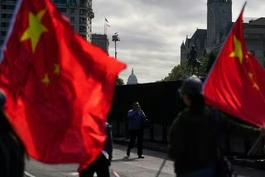 New
NewExperts analyze what's at stake in the Trump-Xi summit
Video has Closed Captions
Experts analyze what's at stake in the Trump-Xi summit (7m 50s)
 New
NewHow diesel prices are rippling through the economy
Video has Closed Captions
How the diesel price spike is rippling through nearly every part of the economy (8m 42s)
 New
NewIn a warming climate, should air conditioning be a right?
Video has Closed Captions
In a warming climate, should air conditioning be a right? (8m 10s)
 New
NewJefferson's hair settles questions about Sally Hemings
Video has Closed Captions
Lock of hair settles questions about Thomas Jefferson and Sally Hemings (7m 43s)
 New
NewKalshi CEO reacts to calls for prediction market regulation
Video has Closed Captions
'We want more guardrails,' Kalshi CEO says as calls grow for prediction market regulation (9m 30s)
 New
NewNews Wrap: Netanyahu dismisses allegations of genocide
Video has Closed Captions
News Wrap: Netanyahu calls allegations of genocide in Gaza ‘the biggest lie' (5m 36s)
Providing Support for PBS.org
Learn Moreabout PBS online sponsorship
- News and Public Affairs

FRONTLINE is investigative journalism that questions, explains and changes our world.

- News and Public Affairs

Today's top journalists discuss Washington's current political events and public affairs.



 New Episode
 New Episode




Support for PBS provided by:
Major corporate funding for the PBS News Hour is provided by BDO, BNSF, Consumer Cellular, American Cruise Lines, and Raymond James. Funding for the PBS NewsHour Weekend is provided by...