Chicago Stories
How Marvin Glass Shaped the Toy Industry
Clip: 10/9/2026 | 7m 6sVideo has Closed Captions
Marvin Glass invented iconic toys – and a new way to get them made.
Marvin Glass got his start creating iconic novelty toys. His firm would go on to invent several classics – and a new method for getting them made.
Problems playing video? | Closed Captioning Feedback
Problems playing video? | Closed Captioning Feedback
Chicago Stories is a local public television program presented by WTTW
Lead support for CHICAGO STORIES is provided by The Negaunee Foundation. Major support is provided by the Abra Prentice Foundation, Inc. and the TAWANI Foundation.
Chicago Stories
How Marvin Glass Shaped the Toy Industry
Clip: 10/9/2026 | 7m 6sVideo has Closed Captions
Marvin Glass got his start creating iconic novelty toys. His firm would go on to invent several classics – and a new method for getting them made.
Problems playing video? | Closed Captioning Feedback
Where to Watch Chicago Stories
Chicago Stories is available to stream on pbs.org and the PBS app.
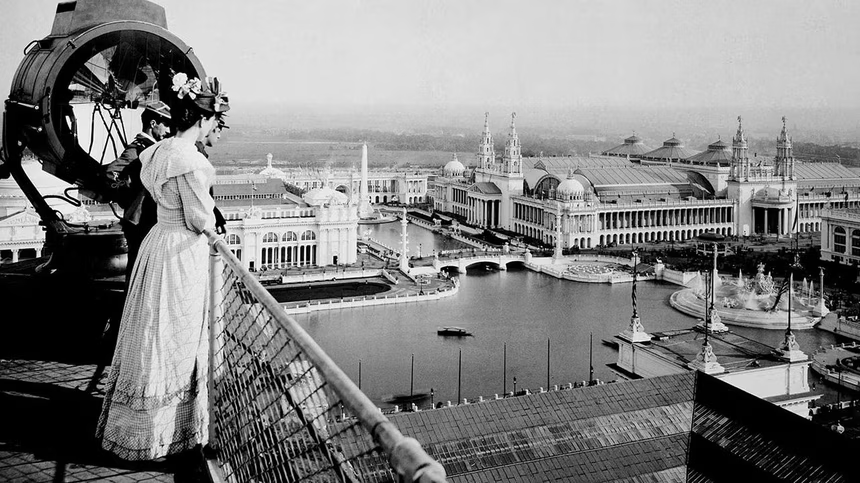
Chicago Stories - New Season!
Season 6 includes: The World’s Fair of 1893, Toy Town, Skyscrapers, and Home of the Irish.Providing Support for PBS.org
Learn Moreabout PBS online sponsorship- [Narrator] In the 1940s and '50s, a new class of toy called novelties flooded the market.
(dramatic music) Unlike toys designed to educate and shape young minds, novelties were small and silly, built simply to delight, trick, or amuse.
(dramatic music) - So a novelty, which was also known as gags, pranks, joker items, they were sold in dime stores.
- [Narrator] Thanks to the advent of plastic injection molding, toys could now be mass produced at low cost.
- It was revolutionary for the toy industry.
Toys really became so much more affordable for families and kids had many more toys to play with.
- [Narrator] In 1947, the $3 million a year novelty industry caught the attention of a 34-year-old toy inventor in Chicago named Marvin Glass.
- Marvin didn't have the easiest childhood.
He had a mother with mental illness that was abusive to him, a father that abandoned him.
He knew poverty, but he persevered.
- [Narrator] Marvin was also a dreamer who channeled his trauma into invention.
When he wasn't given any toys to play with, he created his own.
After college, Glass took a job with a toy company selling paper cutout sets.
A natural salesman and inventor, Glass eventually bought out his partners before going all in on his latest creation.
(dramatic music) (graphics whooshing) A collection of tiny plastic stained glass Christmas tree ornaments.
Glass invested $1 million, but it was a total flop.
He was in debt, left with $300,000 of worthless product.
- It's very high risk and he learned it the hard way 'cause he put all of his eggs in one basket and he lost everything.
- [Narrator] Glass borrowed money to stay afloat.
And in 1948, he got lucky when an inventor named Eddy Goldfarb came knocking.
- It was a match made in heaven because Eddy knew plastics, he was a great inventor.
- [Narrator] Goldfarb had designed a few plastic prototypes, including a set of wind up chattering teeth.
Marvin loved them, and soon struck a deal with a top novelty manufacturer who bought the Yakity-Yak talking teeth for $2,500.
- Arguably the most well-known novelty in the history of the world.
It wasn't licensed.
It was sold outright.
- [Narrator] The $1 talking teeth would go on to earn millions, but Glass and Goldfarb wouldn't receive a penny more.
- It was never ending pain and suffering for Marvin.
Every time he saw it for the rest of his life, all the money that he lost.
- [Narrator] There had to be a better way.
From the Christmas ornament debacle, Glass learned that manufacturing toys was a costly gamble.
After the talking teeth, he vowed to never sell a toy outright again.
These were painful lessons for Glass, but ones that would transform his career and the business of toy invention itself.
- Marvin really invented the business of independent toy design.
You know, you write a book, you make a record.
If it sells a lot, you make a lot of money.
If it doesn't, you don't make anything.
So he looked at this example of what he wanted to do in the toy business.
- [Narrator] Glass would launch an idea factory, the first of its kind.
He would invent toys, license those ideas to the big toy manufacturers, and then watch the royalty checks roll in.
- Marvin was able to license the toy to the Mattels, or the Hasbros, or other companies, which was unheard of at the time.
- [Narrator] Over the next year, Glass and Goldfarb would test this licensing model on some of Goldfarb's other inventions, like the Merry Go Sip, a fun way to get young children to drink their milk.
And the Busy Biddy Chicken, which when pressed would lay white marble eggs.
Kids couldn't get enough of it.
More than 14 million plastic chickens were sold.
Glass and Goldfarb pocketed 5% of each sale, netting $314,000.
(dramatic music) - The more that a company sold, the higher the royalties were for Marvin Glass and his partners.
It truly revolutionized the whole inventing business.
- [Narrator] Goldfarb was ready to strike out on his own.
He moved his family to California and went on to become one of the most prolific toy inventors in history.
Meanwhile, Glass found other idea men to fuel his business.
Over the next decade, he would cement his reputation, inventing novelties like the Hypo-Phony, a fake hypodermic needle, giant glasses called the Super-Specs, and a pile of fake vomit called Whoops.
- Fake vomit.
I mean, it was a hit.
It's still a hit.
(dramatic classic music) - [Narrator] By the mid 1950s, a seismic shift was underway.
The economy was booming and growing families were flocking to the suburbs in record numbers.
Children were now the center of family life, and a new era of consumerism sent the toy industry soaring to new heights.
(dramatic classic music) - The advent of television changed the marketing of toys pretty dramatically, and it shifted parents away from being the primary gatekeepers into these toy companies being able to speak directly to children.
(whistle blowing) - [Announcer] Hey, kids, look.
- [Narrator] The purchase power changed.
It was the kid saying of all these toys and games, that's the one I'm excited about.
That's the one I want.
 New
NewBeanie Baby Mania Began in Chicago
Video has Closed Captions
No toy inspired the level of obsession quite like Beanie Babies. (7m 45s)
 New
NewBuilding Magic with Tinkertoys and Lincoln Logs
Video has Closed Captions
Chicagoans created some of the most popular construction toys of all time. (6m 27s)
 New
NewVideo has Closed Captions
We asked kids to review three vintage toys created in Chicago. (5m 13s)
Providing Support for PBS.org
Learn Moreabout PBS online sponsorship












Support for PBS provided by:
Chicago Stories is a local public television program presented by WTTW
Lead support for CHICAGO STORIES is provided by The Negaunee Foundation. Major support is provided by the Abra Prentice Foundation, Inc. and the TAWANI Foundation.