Here and Now
Dr. Arick Sabin on Rising Lyme Disease Cases in Wisconsin
Clip: Season 2400 Episode 2444 | 5m 44sVideo has Closed Captions
Dr. Arick Sabin on Lyme disease cases with warmer weather extending the deer tick season.
Gundersen Medical Foundation researcher Dr. Arick Sabin describes efforts to diagnose, treat and prevent Lyme disease as cases in Wisconsin spike with warmer weather extending the deer tick season.
Problems playing video? | Closed Captioning Feedback
Problems playing video? | Closed Captioning Feedback
Here and Now is a local public television program presented by PBS Wisconsin
Here and Now
Dr. Arick Sabin on Rising Lyme Disease Cases in Wisconsin
Clip: Season 2400 Episode 2444 | 5m 44sVideo has Closed Captions
Gundersen Medical Foundation researcher Dr. Arick Sabin describes efforts to diagnose, treat and prevent Lyme disease as cases in Wisconsin spike with warmer weather extending the deer tick season.
Problems playing video? | Closed Captioning Feedback
How to Watch Here and Now
Here and Now is available to stream on pbs.org and the free PBS App, available on iPhone, Apple TV, Android TV, Android smartphones, Amazon Fire TV, Amazon Fire Tablet, Roku, Samsung Smart TV, LG TV, and Vizio.
Providing Support for PBS.org
Learn Moreabout PBS online sponsorshipthat we do what's best for Wisconsin.
Merrifield, thanks very much.
>> In other news, with spring starting earlier and warmer weather lingering deeper into the fall, the tick season is expanding.
Wisconsin is already a hot spot for ticks in the U.S.
second in the nation after some locations on the East Coast.
And with the deer tick prevalent across the state, cases of Lyme disease are also on the rise, spiking already this month ahead of last year and 2024 marked a record of nearly 2500 Lyme disease cases in Wisconsin.
Could that be surpassed this year?
Researchers at Gundersen Medical Foundation are staying on top of the disease.
Doctor Eric Sabin leads the research there, and he joins us now.
Thanks for being here, doctor.
>> Happy to do it.
>> How alarming is it that the tick population is growing.
And with it cases of Lyme disease.
>> Well I think that it's it's not going away.
And I think that as a disease in our region, I think we should get pretty that it's a threat that will probably become more common over time, especially when you figure in changes to weather and how often people are outside doing outdoor recreation.
It seems like a thing that's going to be with us going into the future.
>> And so what should people do about that?
I know that you have said that, you know, prevention is better than a cure.
So what's the best prevention here?
>> Generally speaking, be aware that if you're going outside and you're going to be in a place where ticks might be, we know that if you remove these things from you before they've had a chance to attach for too long, the transmission risk of Lyme disease is very, very low or negligible.
So we recommend people be very vigilant to that sort of thing before they once they come back in from a recreational outing.
>> If you do a contract Lyme disease, is there a cure for it?
>> There are exceptional treatments.
We've been using antibiotics for a very, very long time.
Yes, people can be cured, but it's a pretty serious illness and a lot of folks and certainly has no no limits on its ability to produce misery and those who get it.
But yes, we can usually treat people very effectively, especially if we catch the disease early.
>> So what are some of the worst symptoms of it?
>> The ones that patients have told me are the most disturbing are the ones that involve the joints.
And I've had patients that have very significant problems with their mobility and very significant joint pain going into months, sometimes almost a year.
And for people who are otherwise real active or at a real active phase in their life, it can it can significantly disrupt their, major degree.
>> So does it matter if it is diagnosed and treated early versus later?
>> The way that the disease operates is that it produces inflammatory reactions in the human body that that have a tendency to progress, change, and worsen over the course of time if the infection is not treated.
Generally speaking, it's better if you take care of it sooner rather than later.
Lots of the cases don't get recognized until weeks or even months have elapsed, and at that point, the symptoms have oftentimes been much more dramatic.
But generally speaking, it's a good idea to try to get antibiotic treatment for people very soon, and they have a tendency not to then progress into the real serious joint or cardiac or neurological complications after that.
>> How would you know that that you had it early?
>> Well, there are certainly tests that we can use.
A lot of things in medicine depend on clinical context.
And so the it starts with somebody seeking care and bringing up the idea that they may have been outside or may have had tick bites or may have been exposed to ticks.
And then it relies on the part of the health care provider to recognize that it's in our area.
And it has a pretty diverse array of presentations.
And so you combine, you know, the right place at the right time kind of risk factor profile with the person presenting with the right And at that instance, you know, you take action, you can give people treatment.
A lot of times you can prevent things from getting much worse.
>> So has research developed good tests to diagnose Lyme disease?
>> I'm biased.
I think that the testing can work and can be effective in some circumstances, but it has a lot of limits by virtue of how it works.
Most of the present testing is based on immunological reactions through a process we call serology.
And there are pros and cons to that.
Those tests have advantages and that they can show us immunological reactivity and recognition, but they also can be very difficult to interpret.
They don't behave, so to speak, the way that a lot of other serological tests do, because it's a strange disease and we don't really have tests that I think are colloquially as well understood as something like a pregnancy test.
A pregnancy test doesn't leave much doubt about what the result means.
The problem with Lyme disease testing in current use is, is that it's just simply not that straightforward.
In a lot of cases, it can be ambiguous.
>> And so in that instance, if the results are ambiguous, should a patient ask to be treated anyway.
>> I would suggest that any patient have an individual discussion with their provider and make some decision making on what makes sense for the risk benefit.
Pros and cons you know scenario.
You should always be forthright with your doctors about what you know you think is going on.
And health care practitioners should be attentive and mindful of what patients might have experienced in medical school.
They told me, you can't diagnose what you don't think of.
And a lot of times things that are not being considered are diagnoses that can get missed or delayed.
>> Well, thank you for doing that work, doctor doing that work, doctor
 New
NewHere & Now opening for May 15, 2026
Video has Closed Captions
Clip: S2400 Ep2444 | 1m | The introduction to the May 15, 2026 episode of Here & Now. (1m)
 New
NewInside Wisconsin Politics: A Failed Bipartisan Spending Deal
Video has Closed Captions
Clip: S2400 Ep2444 | 5m 3s | Inside Wisconsin Politics on the Legislature voting down a state budget surplus plan. (5m 3s)
 New
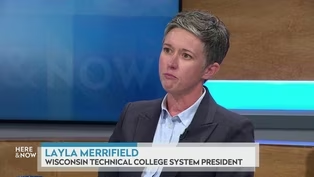
NewLayla Merrifield on Funding for Wisconsin Technical Colleges
Video has Closed Captions
Clip: S2400 Ep2444 | 5m 13s | Layla Merrifield on how a budget surplus deal would have provided aid to tech colleges. (5m 13s)
 New
NewThe Legacy of PBS Wisconsin Emeritus Director Jon Miskowski
Video has Closed Captions
Clip: S2400 Ep2444 | 1m 23s | Jon Miskowski, emeritus director of television for PBS Wisconsin, has passed away at 65. (1m 23s)
 New
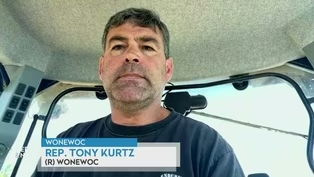
NewRep. Tony Kurtz on Backing Wisconsin's Budget Surplus Plan
Video has Closed Captions
Clip: S2400 Ep2444 | 13m 11s | Tony Kurtz on negotiations for a bipartisan state budget surplus deal that failed to pass. (13m 11s)
 New
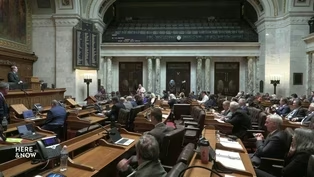
NewWisconsin's Bipartisan State Budget Surplus Deal Falls Apart
Video has Closed Captions
Clip: S2400 Ep2444 | 1m 52s | A bipartisan vote blocked a plan to boost school funds and send checks to taxpayers. (1m 52s)
Providing Support for PBS.org
Learn Moreabout PBS online sponsorship
- News and Public Affairs

Top journalists deliver compelling original analysis of the hour's headlines.

- News and Public Affairs

Today's top journalists discuss Washington's current political events and public affairs.












Support for PBS provided by:
Here and Now is a local public television program presented by PBS Wisconsin